This article is a compassionate guide to understanding the mindset of “living in lack,” how it can show up in destructive behaviours like gambling, and how both the individual and their partner can begin the process of recovery. It’s practical, emotionally grounded, and intended to be a real support for people in crisis and healing. It is not designed to offer mental health prescription, diagnosis or cure. It is a lived experience guide only. Please do contact appropriate local resources if you require more support (links available at the bottom of the article).
What Does ‘Living in Lack’ Mean?
Living in lack means perceiving the world through a deep belief that there is never enough — not enough love, money, time, security, rest, or even worthiness. This mindset is internal and emotionally driven, not based on external resources. It’s not just stress. It’s a chronic, embedded sense of emotional or psychological scarcity that impacts every part of life: relationships, money, self-image, habits, and health.
How Lack is Baked In From Childhood
The lack mindset often begins in childhood environments where emotional, physical, or relational scarcity was normalised. Common roots include:
- Emotional scarcity: Love or approval was conditional on performance or behaviour.
- Inconsistent security: Financial instability or unpredictable parenting created hypervigilance.
- Modeled beliefs: “Life’s hard — get on with it” shaped a worldview that joy, rest, and safety were indulgent or unrealistic.
- Guilt around needs: Expressing desires was shamed or dismissed.
- Neglect or trauma: Emotional self-sufficiency developed in the absence of attunement.
- No emotional vocabulary: Homes lacked space for open expression or reflection.
- Generational trauma: Patterns of survival were inherited through war, poverty, or marginalisation.
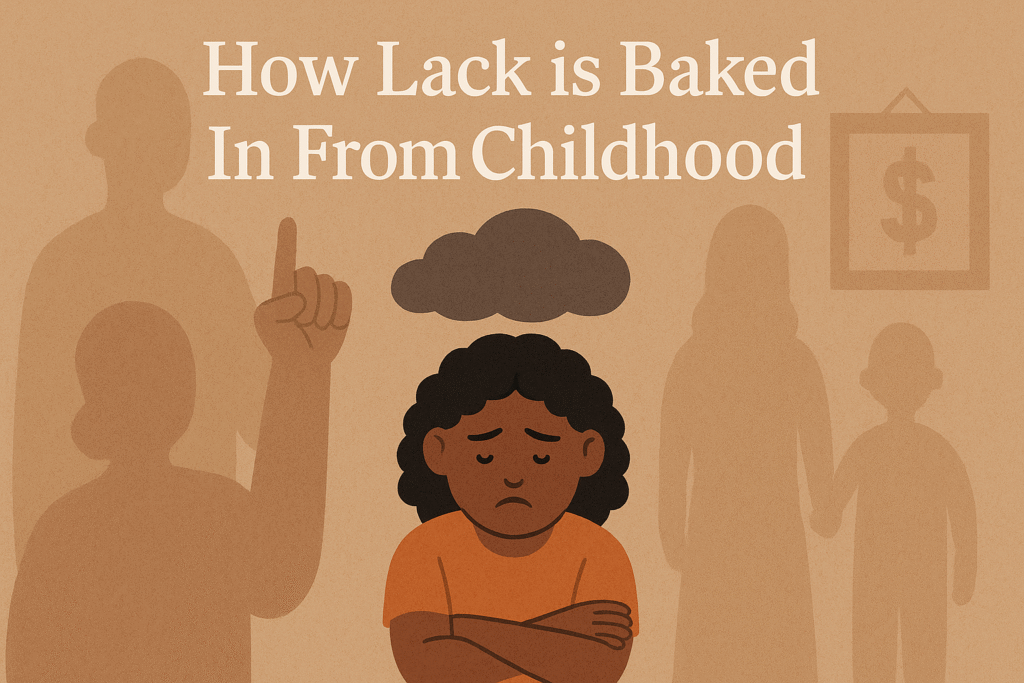
How Lack is Baked In From Childhood
- How Childhood Emotional Neglect Shows Up in Adult Life – Verywell Mind
A clear explanation of how emotional deprivation in early years can manifest in adulthood through avoidance, perfectionism, or low self-worth. - Gendered Childhood Experiences of Material and Emotional Scarcity – Springer
An academic study exploring how early scarcity (both material and emotional) can shape lifelong mental health and relational patterns.
How Lack Shows Up in the Household
A household shaped by scarcity may look like:
- Clutter or hoarding: Fear of waste or future deprivation.
- Under-consumption: Withholding comfort or joy unnecessarily.
- Deferred repairs: Avoidance of investing or improving surroundings.
- Financial fear: Constant tension around spending, even when funds are available.
- No celebration or spontaneity: Life feels functional, not joyful.
- High emotional friction: Control, criticism, or distance becomes normal.
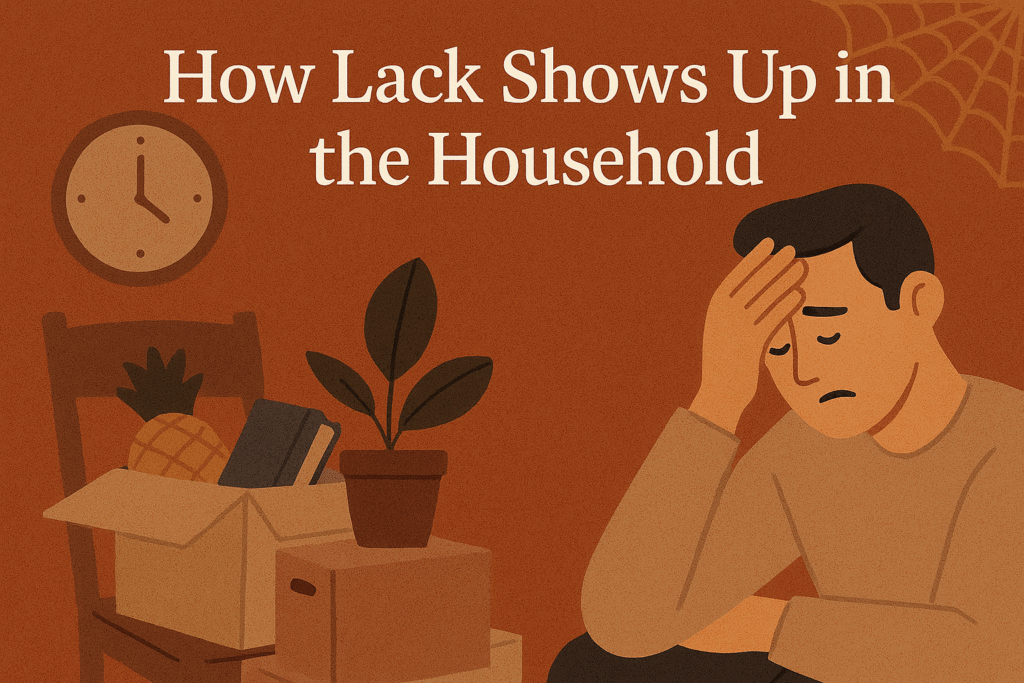
How Lack Shows Up in the Household
- How Clutter and Mental Health Are Connected – Verywell Mind
A practical overview of how disorganisation, clutter, and household neglect can reflect — and reinforce — emotional strain and scarcity.
Can Scarcity Be Misdiagnosed as ADHD or OCD?
Yes. Emotional scarcity can produce behaviours that look like:
- ADHD: Impulsivity, forgetfulness, disorganisation — driven by overwhelm, not neurology.
- OCD: Compulsive checking, perfectionism, control rituals — driven by fear and unpredictability.
The difference:
- ADHD/OCD are neurodevelopmental.
- Scarcity-based behaviours are adaptive responses to a lack of emotional safety.
Misdiagnosis can lead to treating the symptoms without resolving the root — emotional deprivation. Some helpful external articles here may help you better understand the differences that are relevant to your situaiton.
“How OCD and ADHD Similarities Can Cause Misdiagnosis” – Verywell Mind. Useful overview of overlapping symptoms between OCD and ADHD. https://www.verywellmind.com/ocd-and-adhd-2510596 Verywell Mind
“The Perils of Misdiagnosing ADHD When OCD is the Culprit” – Expert Health Articles. Focuses on how OCD can be mis-diagnosed as ADHD. https://www.bvhealthsystem.org/expert-health-articles/the-perils-of-misdiagnosing-adhd-when-ocd-is-the-true-culprit bvhealthsystem.org
“OCD and ADHD Dual Diagnosis, Misdiagnosis and the Cognitive Cost of Obsessions” – IOCDF. Analytical perspective on misdiagnosis and co-occurrence. https://iocdf.org/expert-opinions/expert-opinion-ocd-and-adhd-dual-diagnosis-misdiagnosis-and-the-cognitive-cost-of-obsessions/ International OCD Foundation
“Attention Deficit Hyperactivity Disorder, Impulsivity, Anxiety, and Depression Symptoms Mediating the Relationship Between Childhood Trauma and Symptoms Severity of Obsessive-Compulsive Disorder” – a clinical study linking childhood trauma with OCD and ADHD symptoms. https://www.ncbi.nlm.nih.gov/pmc/articles/PMC7024829/
Gambling and Addiction as Symptoms of Lack
Losing large sums of money through gambling may be labelled as “addiction” – which is true – but it often originates from emotional scarcity.
Gambling becomes:
- A coping mechanism to feel alive, in control, or temporarily “winning.”
- An escape from internal emptiness or shame.
- A way to chase worth or validation through risk and reward.
If only the behaviour is treated, the emotional void remains — and may resurface through other compulsions.
Daily & Weekly Support Structure (Entry Level)
Daily (10–15 minutes total):
- Morning affirmation: “I am enough. I have enough.”
- One act of order: Clean a drawer, desk, or make your bed.
- Notice abundance: One thing you’re grateful for now.
- Digital boundary: Avoid social media first thing; start grounded.
Weekly focus:
- Monday – Emotional check-in: “How am I really feeling?”
- Tuesday – List 3 manageable priorities for the week.
- Wednesday – Reach out to someone (text, call, or connection).
- Thursday – Reflect: “When did I feel safe or unsafe this week?”
- Friday – Joyful choice: One thing done purely for pleasure.
- Weekend – Reclaim one neglected space (home or internal).
Who to Seek for Help (links and resources available at the bottom of the article.
The most effective support comes from practitioners who understand both trauma and behavioural patterns:
- Trauma-informed therapist or counsellor (especially attachment or somatic based)
- Addiction specialist with emotional recovery understanding
- Somatic therapist for nervous system regulation
- Financial therapist or coach (especially with a trauma-aware lens)
- Peer support spaces (e.g., Andy’s Man Club or other men’s groups)
Support for the Partner of Someone Living in Lack
When a partner has betrayed trust through gambling or similar destructive behaviour, the partner often enters a period of grief, confusion, and emotional chaos.

Grievable losses include:
- Emotional safety
- Vision of the future
- Trust
- The sense of “we”
Begin the healing process with:
- Naming the losses (financial, emotional, relational)
- Allowing all emotions without judgement
- Holding two truths: Your partner may still be a good person and what happened may be devastating.
- Setting clear emotional boundaries without shame: “I’m not punishing you — I’m protecting myself.”
- Creating your own healing container — therapy, peer support, journaling, reflection.
You don’t have to decide anything immediately — the goal is to reclaim your emotional footing.
Final Thoughts: Root Before Symptom
Whether you’re the person who’s struggling, or the partner of someone who is, remember:
- Scarcity mindset creates deep, hidden fractures.
- Compulsions (like gambling, control, avoidance) are symptoms — not the core.
- The work is about healing shame, restoring emotional safety, and learning to live in sufficiency.
You’re not broken. You’re surviving something very real. And with the right support, you can move from survival to recovery — and from lack to life.
Confidence & the Lack Mindset: What’s Really Going On
Why Confidence Feels Unreachable in Lack:
- Lack says: “I’m not enough.”
So any attempt to be visible or assertive feels fake or arrogant. - Lack says: “The world will punish me if I get it wrong.”
Confidence feels like a setup for embarrassment or failure. - Lack says: “Others get to feel worthy — not me.”
So even small wins are dismissed or sabotaged (“Yeah, but anyone could’ve done that”).
What Confidence Actually Is (in Recovery from Lack)
Confidence isn’t being sure.
It’s being okay with not being sure — and acting anyway.
Confidence is built through evidence.
Not ego. Not perfection. Not pretending.
It’s the quiet, internal voice that says:
- “I’ll figure it out.”
- “I trust myself to recover, even if I mess up.”
- “I know who I am when things go wrong.”
That’s real confidence — and it can’t exist without self-compassion.
How to Rebuild Confidence When You Live in Lack
1. Stop Performing It — Start Practising It
You don’t need to feel confident to act with courage. You need to act, and let confidence come after.
Action builds evidence.
Evidence builds trust.
Trust builds confidence.
Example: “I don’t know if I’m good at this… but I’m going to try. That counts.”
2. Track Internal Wins
- “I spoke up today when I normally wouldn’t have.”
- “I moved through fear without numbing out.”
- “I owned my truth instead of apologising for it.”
This rewires the brain to notice progress instead of looking for what’s missing.
3. De-attach Confidence from Outcome
Lack says: “I’m only allowed to feel confident if I succeed.”
Healthy confidence says: “I’m proud I tried — regardless of result.”
Try reframing:
- From: “What if I fail?”
- To: “What will I learn — and prove — by trying?”
4. Reclaim Your Past Evidence
People in lack often forget how far they’ve come. They:
- Minimise achievements
- Over-focus on failures
- Ignore survival
Confidence grows when you honour the fact: “I’m still here — and still trying.”
Being Present: The Antidote to Lack
Why It’s Difficult:
Someone living in lack is often stuck in:
- The past (regret, guilt, missed chances)
- The future (fear, planning, bracing for loss)
The present feels unsafe.
It doesn’t offer control. It doesn’t promise outcomes.
So they avoid it — through distraction, anxiety, control, or escapism.
Why It’s Vital:
Presence is where abundance lives.
You can’t feel grateful, connected, or enough unless you’re in the now.
How to Practise It:
- Body scan for 30 seconds: “What sensations am I feeling?”
- Breath anchoring: Inhale for 4, hold for 2, exhale for 6 — 3 times.
- Simple noticing: “I see… I hear… I feel…”
Start small. The goal is not meditation mastery — it’s making now feel tolerable, then comforting, then safe.
2. Prioritising: Replacing Chaos with Clarity
Why It’s Difficult:
Lack creates a brain in survival mode, where:
- Everything feels urgent
- Nothing feels enough
- Busyness replaces progress
They either do everything at once… or nothing at all.
Why It’s Vital:
Prioritising is how we say, “I matter. My time matters.”
It’s the act of choosing what deserves your focus, instead of reacting to everything.
How to Practise It:
- 3-a-day rule: Choose only 3 tasks that move life forward today.
- Triage energy: What’s essential, what’s noise, what’s someone else’s?
- Anchor the week: Start Monday with one personal, one practical, and one emotional priority.
This creates momentum, not overwhelm.
Progress, not panic.
3. Self-Care (Health, Fitness, Wellbeing): Reclaiming Worth
Why It’s Difficult:
People living in lack may believe:
- “I don’t deserve good things.”
- “I’ll care for myself when everything else is fixed.”
- “Rest/joy/nourishment is lazy, selfish, or indulgent.”
They equate self-care with excess, not necessity.
Why It’s Vital:
Self-care is not a reward. It’s proof you believe in your own worth.
Health habits — sleep, food, movement, connection — create internal abundance that challenges the scarcity script.
How to Practise It:
- Start tiny: 5 mins of walking, one nourishing meal, 10 mins of journaling.
- Set non-negotiables: “I hydrate and move because I’m building safety.”
Track how it feels, not just how it looks: “After I moved today, did I feel more capable? Clearer? Softer?
Final Thought:
For someone in lack, these three practices — presence, prioritising, and self-care — are radical acts of rebellion.
They say:
- “I am allowed to slow down.”
- “I’m worth the energy it takes to care for me.”
- “The world is not falling apart if I breathe and choose.”
If You Need More Support
If you or someone you love is struggling with the emotional impact of scarcity, addiction, or relational breakdown, professional and peer support can make a real difference. Healing from “living in lack” takes time and care — you do not have to face it alone. These trusted organisations can offer guidance, counselling, and safe spaces for recovery and reflection:
- Mind (UK): Information, local mental health support, and helplines for anxiety, trauma, and emotional wellbeing.
- GambleAware (UK): Free, confidential support for individuals and families affected by gambling-related harm.
- The Samaritans (UK) / Call: 116 123: 24-hour emotional support for anyone in distress or feeling overwhelmed.
- National Alliance on Mental Illness (NAMI, US): Education, advocacy, and peer-led programmes for people experiencing mental health challenges and their loved ones.
- SAMHSA National Helpline (US) / Call: 1-800-662-4357: Free, confidential, 24/7 treatment referral and information for individuals and families facing mental health or substance use issues.
- Mental Health Europe (EU): A network promoting access to community-based, rights-focused mental health services across Europe.
- IFOTES (International Federation for Telephone Emergency Services, EU): Directory of emotional support helplines available across European countries.
- Relate (UK & Online): Relationship counselling and therapy for couples and individuals navigating emotional or financial strain.
Find More Support and Perspective
If this article resonates with you — if you’ve felt the strain of emotional scarcity, financial pressure, or simply the weight of keeping everything together — you don’t have to carry it alone. At Dads in Business, you’ll find practical tools, honest reflections, and a growing community of dads navigating work, money, and mental wellbeing together. Explore our blogs like Mental Load – Relieving the Burden for Busy Working Dads, which looks at hidden emotional labour; More Than Just Money – Business Enjoyment for Busy Dads, which reframes success beyond financial measures; and The Cost of Money, which explores how financial identity can impact relationships and self-worth.
You’re not broken — you’re human, and you’re not alone in figuring it out.